TOHO Industrial Corp.

Self-Retractable Line

What is Self-Retractable Line


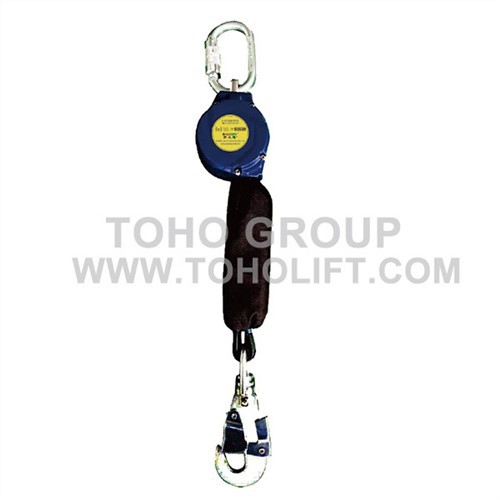
A self-retracting lanyard, also called a self-retracting lifeline or SRL, is a vertical fall protection lifeline that allows users to easily move around while keeping consistent tautness, effectively preventing falls. The lifeline, much like the seat and shoulder belt in a car, also pulls out and retracts easily. In the case of a fall or quick tug, an internal braking mechanism engages, effectively stopping the fall. The lifeline moves freely again after the tension releases.


Advantages of Self-Retractable Line


The preferred solution to all fall hazards is elimination.
Passive fall protection: Physical barriers like guardrails around unprotected edges, for example.
Fall restraint systems are erected so that a fall cannot occur. They use PPE to restrict the worker’s range of movement so they cannot physically travel to the fall hazard.
Fall arrest systems are erected so a fall can occur, but the fall is arrested within the acceptable force and clearance margins. A suitable rescue procedure would then need to be implemented.

Why Choose US


Our factory
As a long history factory, we are first-class in scale, capital, staff,research and development, technology and price. We can provide you best product with best price.

Professional Equipment
We have advanced imported textile machines, dye equipment, computer pattern sewing machine, air compressor and full sets of testing machine, such as Universal Tensile Strength Testing Equipment, Salt Spray Corrosion-resistance Testing Equipment, Webbing Wear-Resistance Testing Equipment, UV lamp testing Equipment,Flame-Resistance testing Equipment, bending test machine, hardness test machine and 8-meter fall attest testing tower, etc.

Professional team
Professional technical personnel and skilled worker keep us at the forefront of the industry. Our products are CE and ANSI certificated. We can produce all kinds of safety harness and accessories in accordance with European standard, American standard and Australian standard. In addition, we can also make customerized style as per your requirement.

Quality control
From raw material control to production process control to finished product testing control, we strictly follow the quality management system. Our factory is ISO9001:2015 certified. Static strength test and Dynamic performance test for our products are conducted according to EN 364. We will do bending, hardness, Salt Spray Corrosion-resistance and tensile strength test for hardware to ensure its quality and your safety. For the webbing, we will do Wear-Resistance Test, UV lamp test and Flame-Resistance test, etc.


How SRLs Compare with Fall Protection Lanyards
High Strength Customizable Retractable Fall Arrester
Retractable Fall Arrester For Working At Heights
Retractable Fall Arrester For Vertical And Horizontal Application
Double Leg Webbing Type Retractable Type Fall Arrester Of Self-Retractable Lifeline

Fall Protection Lanyard is an umbrella term that can refer to different types of products that can fit into either the fall restraint or fall arrest category. Fall restraint devices are designed to keep workers safe by limiting the physical area they can access, while fall arrest devices are designed to slow and stop a worker who has fallen. Both fall restraint and fall arrest devices secure the worker to an anchorage point using a lifeline, harness, and connecting device.
Fall protection lanyards are fixed-length lifelines, often made of rope, webbing, or cable, and are generally shorter than SRLs, which can typically payout up to 30 or even 50 feet. Workers who need fall restraint or work-positioning equipment will typically use a fall protection lanyard that is the correct length for their specific application. When designed for fall arrest, they have a built-in shock absorption feature; this type of fall protection lanyard is known as an Energy Absorbing Lanyard (EAL). When used with an appropriate fall protection system, some EALs may be suitable to use for both fall restraint and fall arrest thanks to the fixed-length design and shock-absorbing capability.
On the other hand, SRLs automatically extend and retract as a worker moves, so they can only be used for fall arrest, not fall restraint. SRLs are also longer than other fall protection lanyards, typically capable of paying out up to 30 or even 50 feet, which allows workers to access locations at different heights. The automatically retracting line ensures there is never any slack in the line so the braking system can engage immediately in a fall event. The longer reach of SRLs means it is important for the line to remain directly over the worker to prevent swing falls. While some fall protection lanyards can be used with any sufficient anchorage point, SRLs almost always require engineered fall protection systems that keeps the device directly overhead to provide the maximum safety benefit.


Single Leg Webbing Type Retractable Type Fall Arrester Of Self-Retractable Lifeline


How SRLs Work

The toothed ratcheting mechanism allows the line—typically made of steel, synthetic cable, or some form of webbing, to payout unimpeded in one direction. A sudden downward acceleration, such as a fall, engages the teeth of the braking system, which arrests the descent.
While the lifeline itself is designed to absorb the shock that comes with a fall, most of today's SRLs provide a smoother stop through the use of a friction control mechanism that limits fall forces to approximately 900 pounds. Additionally, the force of a fall is distributed over a user's body through the use of a full-body harness that connects the worker to the SRL. The smoother stop and arresting force distribution help prevent additional injury to the user.


What Are the Parts of an SRL


The retractable lifeline connects to the worker's body support with a connector hook and will automatically extend and retract as the worker moves. These lifelines are typically constructed of galvanized steel cable, stainless steel cable, or durable webbing.
The housing unit houses the retractable lifeline and features a connection point that attaches to the main anchor point. Some housing units offer an option for a winch to be attached, which can be used to help raise or lower workers to safety in the event of a fall.
Snap hook
The Snap Hook affects the ease and speed of connection. A swivel snap hook provides versatility to allow the Self Retracting Lifeline to be easily connected to a wide variety of anchorages, making it adaptable to different structures.

3-way retrieval option
Some Self Retracting Lifelines incorporate a built in winch retrieval mechanism. These units not only provide fall protection as a user enters a confined space, but also allow activation of a retrieval mechanism for fast, convenient rescue.

I-Safe™
Every Self Retracting Lifeline now comes with i-Safe™, incorporating RFID, web based communications technologies. RFID technology provides you with the ability to track inspections, control inventory and efficiently manage critical safety information.

Line
Self Retracting Lifelines can be made from cable, webbing or synthetic rope. Cable is advised for rugged, outdoor applications or where the line may contact damaging objects. Web is a more lightweight, compact choice, often preferred indoors for warehousing operations. Stainless steel offers the ultimate in corrosion resistance, reliability and longevity.

Impact indicator
Self Retracting Lifelines should be inspected before each use and monthly by the user's designated, competent person. Inspections are made easier with an impact indicator that immediately shows an orange or red band if the Self Retracting Lifeline has been loaded or has arrested a fall. All retractable lifelines should be removed from service following the arrest of a fall and if the impact indicator is visible. In most cases the unit will have to be returned to an authorized service center for service or replacement.

Quick activating braking system
Many Self Retracting Lifelines use a seat-belt type extension and retraction mechanism which can malfunction and lock-up. DBI-SALA Self Retracting Lifelines feature an anti-ratcheting, twin disc brake mechanism that provides smooth operation and locks only when you are ready. Once the mechanism engages, it stays locked, ensuring that the worker is not ratcheted down to the ground.


How to Choose Self-Retractable Line


Job type
The type of connecting device that you select largely depends on the job you intend to complete. Will the connecting device be used primarily for general fall arrest, work positioning, or ladder climbing? For use as a restraint system, you might consider a fall protection lanyard. For use as a retrieval system, an SRL with retrieval capabilities would be a more appropriate choice. Also, ask yourself, where can you install your anchor points? If it's on the walking-working surface, you're likely looking at a fall protection lanyard. If it's overhead, you can use an SRL.

Work radius
With a fixed anchor point, a worker using a fall protection lanyard only has a six-foot radius. This makes for a relatively small region in which to maneuver. If they need to move beyond, they'll need to connect to a new anchor point. With a self retractable lifeline, however, that same worker can cover much more ground.

Fall clearance
In addition to work radius, you also need to think about fall clearance. Fall clearance is the minimum vertical distance required between an employee's feet and a lower level. When the fall clearance remains constant, choosing a lanyard may make sense. However, if a worker's distance changes throughout the day (think: adding floors to a construction frame), then a self retracting lifeline may be the more effective option.

Leading edge work
Many self retracting lifelines are designed to be anchored to an overhead anchor point. This is often impossible in leading edge applications-forcing the user to use the SRL horizontally. Keep in mind, though, not all SRLs are fit for horizontal use. Over time, if a self retracting lifeline repeatedly travels over the edge of a flat surface, the webbing can begin to fray. Furthermore, the force generated by a fall arrest over a 90° angle can be strong enough to break through the lifeline altogether. In this case, fall protection lanyards are a safer bet.

Work Environment
The environment in which the SRL will be used plays a significant role in selection. For instance, some SRLs are designed with special features to accommodate sharp edges, which can damage standard lifelines. These specialized SRLs have more robust line materials or an energy absorber that protects the line from edge damage in a fall. On the other hand, if the work is in an environment with certain chemical exposures or extreme temperatures, an SRL designed for chemical or heat resistance would be more suitable.

Length of Line
The length of the SRL line should match the working height and coverage area. The line should be long enough to allow the worker to move freely within the working area but not so long that the worker could fall a dangerous distance before the line arrests the fall. In other words, the line's length should limit the free fall distance to a minimum, typically no more than six feet.

Material
The material of the line can vary based on the work environment and application. Wire rope lifelines are often preferred when there's a risk of cutting or abrasion, as they are more durable and resistant to these hazards. In contrast, synthetic rope or web lifelines are generally lighter, making them more comfortable and less restrictive for workers, especially for long durations. These are typically more suited for applications where the worker needs maximum mobility and cutting or abrasion risks are lower.

Connector Type
The SRL should have a connector compatible with the worker's full-body harness and the selected anchor point. Connectors come in various styles, including snap hooks and carabiners, and they should be selected based on compatibility, ease of use, and the type of anchorage or harness they will be connected to. The connectors should meet or exceed the relevant strength requirements and be self-closing and self-locking to prevent accidental disengagement.

Weight Capacity
The SRL must be rated for the combined weight of the worker and their tools. This includes the worker's body weight, clothing, and any tools or equipment they'll be carrying while working at heights. Most SRLs will support a wide range of weights, but it's critical to verify that the SRL's weight capacity exceeds its total load to ensure safety.


Self-Retracting Lifelines Vs Lanyards - Key Differences


Feature

Self-Retracting Lifeline (SRL)

Lanyard

Function

Automatically retracts and extends to minimize fall distances

Provides a fixed-length connection between the user and the anchor

Work Radius

Offers greater mobility due to retractable line

Fixed length limits movement

Fall Arrest

Designed for active fall arrest; can reduce fall arrest forces

Primarily used for fall arrest, but with less dynamic adjustment to fall forces

Compatibility

Must be used with a full-body harness; specific models for specific applications

Must be used with a full-body harness; more universally compatible

Cost

Generally costs more than other safety gear

Less expensive as it involves simpler technology


How To Inspect Your Self-Retracting Lifeline
 

Pre-use inspections are a must for self-retracting lifelines. Do not use a device that hasn't passed inspection.


Start by inspecting the housing for cracks or damage. Do not open the casing unless you are authorized or trained to do so. You should be able to read the date of manufacture, serial number, manufacturer information, and warning information on the label. If not, remove the device from service.


You must put on gloves and mount the SRL before examining or using the lifeline. Never pull it out or let it retract while lying flat.


Slowly pull the cable out, looking for rust, cuts, pitting, corrosion, deterioration, modifications, or frayed, worn, or broken strands. Also check for crushed, jammed, or flattened strands, bulges in cable, gaps between strands, and heat damage, such as torch burns and electrical arc strikes. There shouldn't be kinks, bird caging, core protrusion, or frozen wire rope. If you find any of these damages, remove the device from service.


For webbing, search for holes, tears, abrasions, discoloration, and fraying. Be sure to check both sides, pulling on the webbing as you go. Bend the lifeline into a U-shape to look for shiny spots or broken fibers. Take off your gloves and feel for hard spots. Make sure there isn't any loose stitching and that the wear pad is present. If you find any holes or tears, remove the lifeline from service. If more than 10% of the lifeline has other damage, remove it from service.


There should be no cracks, bends, or discoloration on the carabiner. Test the lock to make sure it functions properly. The mechanism should move smoothly and lock by itself without catching when released.


Next, do a retraction and tension test. Pull out 50% of the lifeline, maintaining light tension on it, then let it retract. Repeat the test after pulling out 100% of the lifeline. Always keep light tension to keep the lifeline from retracting too quickly. All movement, in or out, should be smooth.


Finally, conduct a braking test. Give sharp, steady tugs to the lifeline to engage the brakes. Hold tension on the lifeline until the brakes are fully engaged. You shouldn't see any slippage while the brakes are engaged. Release the lifeline and allow it to retract under light tension. It should retract smoothly. Repeat the test with the lifeline pulled out at different lengths. If you see any problems, remove the device from service.


How to Maintain Your Self-Retracting Lifeline

Lifeline maintenance is important because it keeps your equipment functional and ready to save lives when needed. While proper pre-use inspections can catch potential problems, caring for your equipment can help prevent issues from developing.
When an SRL is not in use, follow the manufacturer’s directions for storage methods. Generally, these devices should be kept somewhere cool and dry, away from moisture and direct sunlight.
Freewheeling is one of the most common causes of lifeline damage. When you completely release the lifeline rather than maintaining light tension as it retracts, the spring will coil too fast. Sometimes, this leaves some of the lifeline hanging out of housing since it didn’t coil tightly enough. Other times, the hook or karabiner hits the housing at high speeds once the cable retracts, engaging the lock mechanism. Someone then has to find a way to safely climb up to the housing unit to release the cable for future use.

Single Leg Webbing Type Retractable Type Fall Arrester Of Self-Retractable Lifeline


FAQ
 

Q: What is the Primary Difference Between Lanyards and Srls?

A: The primary difference between lanyards and SRLs is that lanyards offer a fixed length of safety protection. In contrast, SRLs offer more mobility due to the retractable lines used to arrest a fall.

Q: How Long Are Self-Retracting Lanyards Good for?

A: Generally, SRLs don't have an expiration date as long as they are correctly maintained and pass mandated inspection deadlines. However, some manufacturers suggest replacement timelines of 5-10 years to protect against unforeseen wear.

Q: Can a Self-retracting Lifeline Be Used With a Shock Absorbing Lanyard?

A: Due to the components of each device, it's not advisable to use a self-retracting lifeline with a shock-absorbing lanyard. When combined, the locking systems and fixed length of the lanyard could cause mechanical issues.

Q: How Often Should Safety Lanyards and SRLs Be Inspected?

A: According to OSHA guidelines, safety lanyards and SRLs should be inspected by a qualified inspector before each use and at least once per year.

Q: Can a Self-Retracting Lifeline Be Used for All Types of Work?

A: Self-retracting lifelines can be used for all types of work, including construction, tree cutting, and other forms of elevated work where safety is a concern.

Q: What are the benefits of using an SRL?

A: There are several benefits of using an SRL, including that they can arrest a fall and limit the distance a worker can fall. Additionally, SRLs are easy to use and require little maintenance. They are also versatile and are used in a variety of applications.

Q: How often do I need to inspect my SRL?

A: You should inspect your SRL before each use. Additionally, have your SRL inspected by a qualified person at least once a year.

Q: How do I care for my SRL?

A: You should store your SRL in a cool, dry place when it is not in use. Additionally, you should regularly inspect your SRL for damage and replace any damaged parts.

Q: How do self-retracting lifelines work?

A: Mechanically, SRLs function like a tape measure, but have an internal braking system that works like a seatbelt. You can pull the lifeline out and let it retract smoothly. If you give it a sharp tug, such as the sudden force applied during a fall, the braking system engages and locks the lifeline in place to minimize the freefall distance.

Q: How does a self-retracting lifeline protect you if you fall?

A: The automatic braking system slows you down and limits the distance that you fall. You experience less force on your body and remain suspended until rescue.

Q: How long are self-retracting lifelines good for? Do they expire?

A: As long as your SRLs pass inspection and meet manufacturer guidelines, they are safe to use. There is no shelf life or expiration date for a self-retracting lifeline.

Q: What is the maximum length for a self-retracting lifeline?

A: Since self-retracting lifelines use an automated braking system, there is not a mandated maximum length. The maximum length available varies by manufacturer.

Q: What is the maximum weight a self-retracting lifeline can support during a fall?

A: ANSI mandates that self-retracting lifelines must support as little as 130 lbs and as much as 310 lbs. Some SRLs have a higher capacity, but the maximum weight threshold will vary by manufacturer.

Q: Why would a worker use a self-retracting lifeline when working from heights?

A: The automated braking system on an SRL reduces the fall distance and makes rescue easier. Its additional length and ease of movement also support many more applications than a lanyard. For these reasons, self-retracting lifelines are superior to other connectors and often the better choice.

Q: What is SRL used for?

A: Self- retracting lifelines (SRLs) allow the lifeline to extend and retract as the worker moves. Connecting an SRL to a fall-arrest system will limit the distance a worker can fall.

Q: What is the difference between a SRL and PFL?

A: PFLs are generally a more compact, lightweight version of a self-retracting lifeline. They connect directly to the D-ring of a body harness and provide working lengths from 6 to 9 feet. SRLs are generally larger and heavier than PFLs, connect directly to an anchor point, and provide longer user working lengths.

Q: What is the difference between a lanyard and a SRL?

A: SRLs provide shorter fall distances compared to energy-absorbing lanyards. During a fall event, the SRL's internal braking mechanism will ensure the worker comes to a stop. SRLs are a great option when the anchor point is overhead.

Q: What is the difference between SRD and SRL?

A: SRD (self-retracting device) and SRL (self-retracting lifelines/lanyards) are two names for the same thing. Most companies use the term SRD for personal-sized devices and SRL for personal-sized and larger mounted devices. We use the term SRD, but you may hear SRL elsewhere.

We're well-known as one of the leading self-retractable line manufacturers and suppliers in China. Please feel free to buy customized self-retractable line made in China here from our factory. Good service and quality products are available.

, free fall safety harness
goTop

(0/10)

clearall