TOHO Industrial Corp.

Full Body Safety Harness

What is Full Body Safety Harness


A full body harness is a safety harness that connects the worker to the fall protection system anchored into the structure they're working on. Using a series of straps that fit around the thighs, hips, chest, shoulders, and back, these harnesses arrest falls while minimizing injury to the worker. Full body harnesses are also designed to keep wearers upright after a fall to prevent suspension trauma and facilitate faster rescue.


Advantages of Full Body Safety Harness


Fall protection: The purpose of wearing a fitted full body harness and lanyard correctly is to prevent falls from height. By using appropriate anchorage points that should be positioned above the worker, will reduce the distance of the swing if a fall were to occur. This protects the worker from impacting any equipment or building by acting as a barrier, minimising the risk of serious injuries or fatalities.

Increased Stability: To improve the performance of completing a task by keeping a worker stable and balanced while working at height. The straps featured on a harness can be adjusted to fit securely and centred around the body reducing the stress and fear of falling from height. This stability allows workers to maintain control of their movements.

Hands-Free Operation: Harnesses often includes multiple attachment points for tools and equipment, allowing workers to have their hands free while working at height. This feature improves productivity and enables the completion of complex tasks that require the use of both hands. It also prevents the risk of injuring others on the ground if a tool were to accidentally slips from a worker's hands.

Distribution of impact forces: The body harness straps that are positioned over the shoulders, chest, waist, and shoulders are designed to distribute the forces exerted on the body during a fall. If your harness is incorrectly worn, the forces encountered will be diverted to a vulnerable part of the body, resulting in severe injury and suspension trauma.

Psychological Comfort: By wearing a full body harness the right size that is not too tight or loose can provide comfort and confidence to workers when performing tasks at height, especially at awkward angles where you do not want the material of the harness to restrict mobility. Having psychological discomfort can impact focus and concentration, so it is important to prioritise a worker's comfort to improve their overall well-being.

  • Dielectric Safety Harness

    Dielectric Safety Harness

    1-5 D-rings made of steel coated Nylon injected to electrically isolate 5,000 Pounds2- 1 big dorsal ergonomic plastic device for routing the straps.3-Green and black polyester 45mm polyester with

    Add to Inquiry
  • 5 D Ring Harness

    5 D Ring Harness

    • Attachments – 1 Chest D-Ring and a Dorsal D-Ring for Fall Arrest. 1 D-Ring at front waist for climbing. 2 Lateral D-Rings for Work Positioning.• Adjustments – 6 Points Adjustments at Shoulders,

    Add to Inquiry
  • Restraint and rope access safety harness

    Restraint and rope access safety harness

    1 Dorsal & 1 Stemal D-Ring for Fall Arrest . 1 Ventral D-Ring at waist level in front for Rope Access . 2 lateral D-Ring at waist level on the sides for work positioning . Convenience – Shoulder

    Add to Inquiry
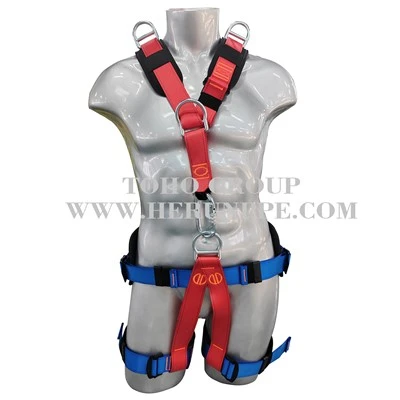
  • Roof workers harness kit

    Roof workers harness kit

    • Attachments – 1 Chest D-Ring and a Dorsal D-Ring for Fall Arrest. 1 D-Ring at front waist for climbing. 2 Lateral D-Rings for Work Positioning.• Adjustments – 6 Points Adjustments at Shoulders,

    Add to Inquiry
  • Full Body Harness For Working At Height

    Full Body Harness For Working At Height

    Material: 100% Polyester, 25kN.Attachments: 1 Dorsal D-ring for fall arrest.Adjustments: 5 points adjustments.Convenience: Lanyard Keepers on the Shoulder straps are for placement of free

    Add to Inquiry
  • Power supplies and arborist safety harness with working positioning function

    Power supplies and arborist safety harness with working positioning function

    1 Dorsal and 1 Sternal D-Ring for Fall Arrest . 1 Ventral D -Ring at waist level for Rope Access work . 2 Lateral D- Rings for Work Positioning .

    Add to Inquiry
  • EN 361 Full Body Harness

    EN 361 Full Body Harness

    • Attachments – 1 Dorsal D-Ring for Fall Arrest and 2 Lateral D-Rings for Work Positioning.• Adjustments – 4 Points Adjustments at Chest, Waist and Thigh to adjust the length of straps. .•

    Add to Inquiry
  • Construction full body harness

    Construction full body harness

    • Attachments – 2 Chest textile loops and a Dorsal D- Ring for Fall Arrest.• Adjustments – 5 Points Adjustments at Chest, Shoulders and Thigh to adjust the length of straps. • Convenience – Shoulders

    Add to Inquiry
  • Multipurpose Safety Harness

    Multipurpose Safety Harness

    Attachments – 1 Dorsal & 1 Sternal D-Ring for Fall Arrest.2 Lateral D-Rings at waist for Work Positioning.Equipped with Light Weight Aluminium D-Rings at back and waist.Adjustments – Adjustable

    Add to Inquiry
  • Four D ring safety harness

    Four D ring safety harness

    • Attachments – One Chest D- Ring and a Dorsal D-Ring for Fall Arrest. Two Lateral D-Rings for Work Positioning.• Adjustments – 6 Points Adjustments at Chest, Waist, Shoulders and Thigh to adjust the

    Add to Inquiry
  • Full body harness with front d ring

    Full body harness with front d ring

    1. Ansi Z359.11 Standard Compliance;2. Multiple Attachment Points;3. 5 Points Adjustments;4. Durability and Comfort;5. High Visibility

    Add to Inquiry
  • Fall Arrest Security Harness

    Fall Arrest Security Harness

    Attachments – 1 Dorsal & 1 Sternal D-Ring for Fall Arrest.2 Lateral D-Rings for Work Positioning.Equipped with Light Weight Aluminium D-Rings.Adaptability – Adjustable shoulder, thigh – straps &

    Add to Inquiry
First 1234567 Last 1/8
Why Choose US


Our factory
As a long history factory, we are first-class in scale, capital, staff,research and development, technology and price. We can provide you best product with best price.

Professional Equipment
We have advanced imported textile machines, dye equipment, computer pattern sewing machine, air compressor and full sets of testing machine, such as Universal Tensile Strength Testing Equipment, Salt Spray Corrosion-resistance Testing Equipment, Webbing Wear-Resistance Testing Equipment, UV lamp testing Equipment,Flame-Resistance testing Equipment, bending test machine, hardness test machine and 8-meter fall attest testing tower, etc.

Professional team
Professional technical personnel and skilled worker keep us at the forefront of the industry. Our products are CE and ANSI certificated. We can produce all kinds of safety harness and accessories in accordance with European standard, American standard and Australian standard. In addition, we can also make customerized style as per your requirement.

Quality control
From raw material control to production process control to finished product testing control, we strictly follow the quality management system. Our factory is ISO9001:2015 certified. Static strength test and Dynamic performance test for our products are conducted according to EN 364. We will do bending, hardness, Salt Spray Corrosion-resistance and tensile strength test for hardware to ensure its quality and your safety. For the webbing, we will do Wear-Resistance Test, UV lamp test and Flame-Resistance test, etc.


Roof Climbing Harness

Types of Full Body Safety Harness

1-point harness
1-point harnesses are some of the simplest and most cost-effective harnesses on the market. They are great for working in environments where you need the security of the harness but a good range of movement. With a single attachment at the rear, you can easily connect and disconnect from your safety lanyard as required.

Multi-purpose harness

If you need a good all-rounder harness for a range of applications, look no further than our multi-purpose harnesses. Whether you're a professional looking for a harness for work, or a recreational climber in need of some new gear, our multi-purpose harnesses won't let you down.

Work positioning harness

Work positioning harnesses (also known as sit harnesses) are designed to provide maximum comfort and security when you're working at height for long periods of time. They're favoured by arborists because they provide complete support around the waist and legs while leaving the arms free to work.

Rescue/confined space harness

When you're working at height or in a confined space, there's always a risk that something can go wrong. With the right equipment on hand (a rescue or confined space harness) you'll be able to move injured or trapped climbers to safety in no time.

Rope access harness

Finally, we have our rope access harnesses. These are designed for both professional and recreational use & are perfect for scenarios such as abseiling. They are tested to the relevant health and safety standards, so you can rest assured that you're in good hands while you're working at height.


Basic Components of a Full Body Safety Harness


A full-body harness combines the features of a chest harness and a sit harness to support the upper legs, hips, chest, and shoulders. The primary components of a safety harness system include:
Straps: Saftey harnesses contain different fabric types and webbing sewn together to form the system's waistband and various straps. Typical materials include polyester and nylon for standard systems and fabrics like Kevlar®, Nomex®, and Dyneema® for specialized applications. Padding sewn into the straps - particularly in the shoulder area - maximizes comfort and functionality.
Buckles: The straps use buckles to tighten the harness system around the worker's body. Common types of buckles include quick attachment, tongue, and spring tension. The straps and buckles are fully adjustable to accommodate each worker's weight while providing comfort while working.
Attachment points: The harness's webbing contains various sewn-in attachment points made from plastic or forged metal. The locations of these points depend on the specific harness type and its application. Examples of attachment points include a D-ring on the back of the system, grommets on the waistband, and keepers to stow idle lanyards.
Attachments - Standard steel or aluminum D-ring attachments are adequate for almost every situation, which is why they are used in nearly 90% of fall protection harnesses.
Additional Features - Depending on the work, harnesses may also include seat support, padded belts, belly belt buckles, reflective materials, and additional D-ring attachments.


Ensuring the Proper Fit
 

Hold and shake it
Pick up the harness by the dorsal D-ring and shake it so the leg straps fall down. Everything should hang like it would when worn, so you can check for any loose or twisted straps. You should also buckle any open buckles.


Put it on
First, place the harness over your shoulders like you would a shirt or jacket. The dorsal D-ring should be right between your shoulder blades. If it's not, adjust it to the correct position.
Next, check the harness from the bottom up. Make sure the sub-pelvic strap is resting just under the buttocks so it will catch your weight correctly. Then, secure the leg straps. You should be able to place only two or three fingers beneath the straps when tightened. Before moving to the chest strap, check the sub-pelvic strap's position again.
Check your shoulder straps, which should be spaced evenly across your chest with the straps running vertically down your body. Both straps should both be the same length. Buckle the chest strap, which should be sitting along your mid-chest. Any higher or lower and the chest strap won't function properly.


Evaluate the fit
Now, straighten up and adjust any straps to feel snug but not tight. Use a mirror or a partner to visually inspect the fit as well. If it feels too tight or too loose, it isn't safe for you to use. This is a piece of equipment that you may use all day, every day, so it needs to fit well and comfortably in its proper configuration.


How to Inspect a Full Body Harness
Power supplies and arborist safety harness with working positioning function
Working Positioning Safety Belt
Full body rescue safety harness for confined space
Roof Climbing Harness

Check the impact indicators
Your safety harness likely includes a feature known as impact indicators. Though they can take a variety of forms, these features are always intended to show when the harness needs to be replaced or repaired. If the impact indicator is not there or is exposed, depending on the method used, remove this harness from service.

Labels
If you can't read what the labels on your gear say, you shouldn't use it. This information is critical for proper use and safety, so you need to be able to read it.

Hardware
To check the hardware, start at the top of your harness and work your way down. Inspect the dorsal D-ring for cracks, discoloration, and other damage. Make sure your chest strap buckle locks and stays together securely. Check any rollers and springs for proper function. Any mating buckles should allow webbing to move through them freely. Every part of every buckle, from grommets to tongues, should work well and be in good shape.

Webbing
Before you inspect your webbing, remove your gloves. Run your fingers along the materials to check for thinning and stretching. If the edges have more than 10% wear, the harness needs to be repaired. Look for tears, holes, and discoloration. As you go, invert the webbing in a u-shape to expose hidden damage. Lastly, make sure there aren't any loose or missing stitches, particularly on the sub-pelvic strap.


When Should You Wear a Full Body Harness
 
Tower/Climbing

When climbing towers or other structures, there are several things to take into consideration. This work takes place outside, so you need to evaluate the weather conditions your workers will face. Climbing takes a lot of strength, so you may want to choose harnesses with lighter components to reduce the weight your workers have to carry. Tower climber harnesses should also include seat support for comfortable suspension.

Utilities/Arc Flash

Working with utility infrastructure may put your workers at risk for contact with electricity. In these situations, employees may experience a phenomenon called arc flash. Occasionally, some of an electric current may unexpectedly arc away from the flow and connect to another conductor, such as someone standing nearby. When it happens, arc flash can cause life-altering injuries and even death.
To minimize the chances of attracting electricity, utilities and arc flash harnesses use specific arc-resistant materials, including black Kevlar, Nomax, leather, plastic, and insulated/dielectric steel attachments. In this field of work, balancing fall protection with arc-flash resistance is essential. Thankfully, there are numerous full body harnesses designed specifically for this need.

Oil & Gas

Workers in the oil & gas industry face difficult working conditions and significant hazards in their everyday tasks. They often have to climb ladders that are slippery with ice, water, and grease, moving from ladder to ladder to reach their destination. Even the platforms are treacherous and at great heights. With all of these dangers, fall protection is a high priority.
The safety harnesses used for the oil & gas industry use a variety of D-ring attachments and connection points, including hip-lifting D-rings and buckles that enable belly belt attachments. This allows workers to adjust their safety equipment to meet the requirements of different tasks. This equipment protects workers from falls and simplifies the difficulties of their work for reliable safety.

Traffic

In addition to the typical hazards of construction work, teams that work on roads, bridges, and other traffic-related infrastructure are also exposed to driving dangers. Since most of this work takes place on or near busy roads, you need fall protection equipment that will keep your workers visible at all times.
Traffic safety harnesses are typically paired with vests or straps made from reflective materials. When hit with light from a car or workplace lights, these harnesses flash to identify the worker’s location. At night and in low-visibility situations, this equipment can protect workers from horrible collisions. Beyond the reflective straps, traffic harnesses are similar to standard or construction harnesses. They may include padded belts for tools, but they don’t require any additional specifications.

Confined Space

Numerous industries require workers to climb or crawl into confined spaces such as crawl spaces and tunnels. In these situations, OSHA requires employers to provide safety harnesses that simplify rescue if needed. Along with a full body or chest harness, workers need retrieval lines that are attached between the shoulder blades or above the user’s head.
These design details ensure that workers can be lifted or removed from the tight spaces without endangering other workers. It also speeds up potential rescue efforts to minimize danger and injury to the people involved.


How to Maintain Full Body Safety Harness


To maintain service life and high performance, you should inspect harnesses frequently. Visual inspection before each use is required. Regular inspection by a competent person for wear, damage, or corrosion should be a part of your safety program. Inspect your equipment daily and replace it if any defective conditions exist.

Webbing
Grasp the webbing with your hands 6 to 8 inches apart. Bend the webbing in an inverted "U" as shown. The resulting surface tension makes damaged fibers or cuts easier to see. Follow this procedure the entire length of the webbing, inspecting both sides of each strap. Watch for frayed edges, broken fibers, pulled stitches, cuts, burns, and chemical damage.

D-Rings/Back Pads
Check D-rings for distortion, cracks, breaks, and rough or sharp edges. The D-ring should pivot freely. D-ring back pads should also be inspected for damage.

Attaching Buckles
Attachments of buckles and D-rings should be given special attention. Note any unusual wear, frayed or cut fibers, or distortion of the buckles or D-rings.

The Tongue/Grommets
The tongue receives heavy wear from repeated buckling and unbuckling. Inspect for loose, distorted, or broken grommets. Webbing should not have additional punched holes.

Tongue Buckle
Buckle tongues should be free of distortion in shape and motion. They should overlap the buckle frame and move freely back and forth in their socket. Roller should turn freely on frame. Check for distortion or sharp edges.

Friction and Mating Buckles
Inspect the buckle for distortion. The outer bars and center bars must be straight. Pay special attention to corners and attachment points of the center bar.

Visual Indications of Damage to Webbing and Rope
a) Heat. In excessive heat, becomes brittle and has a shriveled brownish appearance. The fibers will break when flexed. Should not be used above 180 degrees Fahrenheit.
b) Chemical. Change in color usually appearing as a brownish smear or smudge. Transverse cracks when bent over a mandrel. Loss of elasticity.
c) Molten metal or flame. Webbing strands fuse together. Hard shiny spots. Hard and brittle feel.
d) Paint and solvents. Paint that penetrates and dries restricts movement of the fibers. Drying agents and solvents in some paints cause chemical damage.


FAQ
 

Q: What is the purpose of a full body safety harness?

A: A full body harness is a safety harness that connects the worker to the fall protection system anchored into the structure they're working on. Using a series of straps that fit around the thighs, hips, chest, shoulders, and back, these harnesses arrest falls while minimizing injury to the worker.

Q: What is the difference between a safety belt and a full body harness?

A: As opposed to the body belt that fit only around a person's waist, a body harness fits around a person's legs, over their arms, and around their torso.

Q: What are the different types of safety harnesses?

A: These include full-body harnesses, 1-point harnesses, 2-point harnesses, multi-purpose harnesses, work positioning harnesses, rescue/confined space harnesses, rope access harnesses, and more. Each type has its unique features and benefits that make them suitable for different situations.

Q: What is a Type A full body harness?

A: Class A (Fall Arrest) harnesses support your body during and after a fall. These harnesses protect you when you are 1.8M (6ft) or more above the ground. They have a single dorsal D-ring positioned on your back's upper spine between your shoulder blades to keep you in an upright position.

Q: What are the pros and cons of a full body harness?

A: A full-body safety harness will be lightweight and easy to put on as well as having lots of attachment points for other safety equipment (e.g., lanyards). The disadvantages are mostly related to air flow – they can be hot in warm weather conditions or some people may find them too restrictive when it comes to movement.

Q: How many types of full body harness are there?

A: FULL BODY HARNESS: D, A, P, L, E Class Harness, An extensive range of safety harnesses which conforms to Indian standards (BIS certified). The harnesses are made of high tenacity Polyester webbing with attached lanyards on request.

Q: Should I use a fall body harness or full body harness?

A: Full body harnesses distribute fall arrest forces across the shoulders, upper thighs, chest, and pelvis. Fall arrest harnesses feature a dorsal D-ring for attaching to the connector such as a lanyard and may have other D-rings for use in worker positioning, travel restraint, retrieval or ladder climbing.

Q: Is body harness a PPE?

A: Safety harnesses are considered Personal Protective Equipment (PPE). Each type of harness must meet a specific standard. A full body fall arrest harness must comply with EN 361. These harnesses have built-in attachment points to the fall arrest system and are usually located on the back and chest.

Q: Is a full body harness attached to a lanyard?

A: A lanyard is a short, flexible line of rope, wire rope, or webbing strap with connectors at each end. Lanyards are attached to a full body harness at one end, and to a deceleration device, shock absorber, anchorage connector, or anchorage point at the other end.

Q: What are the two basic safety harness styles?

A: Two basic types of fall protection are travel restraint and fall arrest. Both involve wearing a full-body harness. A travel restraint system keeps you from getting too close to an unprotected edge. The lifeline and lanyard are adjusted to let you reach the edge but not fall over it.

Q: What are the rules for safety harnesses?

A: Personal fall protection systems must be worn with the attachment point of the body harness located in the center of the employee's back near shoulder level. The attachment point may be located in the pre-sternal position if the free fall distance is limited to 2 feet (0.6 m) or less.

Q: What class is a full body rescue harness?

A: They wrap over a person's shoulders, around the waist, and around the upper legs for full-body support. They have multiple D-rings attached to them so they can be secured to a line at various angles.

Q: How do I choose a full body harness?

A: A harness should have hardware that's sturdy, but not oversized and awkward. At the same time, the hardware should easily attach to connecting devices. For example, the D-rings on some harnesses are so small that hooking a lanyard can be a tricky process. Harness hardware also poses a hazard if it has sharp edges.

Q: Do we need to inspect the full body harness before use?

A: Most harnesses are made from webbing straps. These should be inspected for fraying or cuts, badly pulled webbing, loose stitching, as well as UV damage. Buckles connect the straps. They can be rigid plastic or metal.

Q: What is the first step after a fall while wearing a full body harness?

A: If they can't relieve the pressure the harness places on their legs, blood flow can be restricted causing a situation known as suspension trauma, the results of which can be mild discomfort to lost consciousness. The first thing a fallen employee should do is relieve harness pressure with a foot wrap or trauma straps.

Q: What is the maximum weight for a full body harness?

A: A rated capacity or weight limit is assigned to all full-body harnesses. The capacity range is between 130 – 310 pounds (59 – 140 kg) and comes from the ANSI equipment regulation.

Q: At what height more than full body harness should be used?

A: Full body harness with double lanyard shall be worn when work requires persons closer than 1.8 meters from roof edge without parapets, or floor opening.

Q: At what height is a safety belt required?

A: Explained. Currently, OSHA requires that employers provide fall protection for construction workers on a walking or working surface with an unprotected edge that is 6 feet or more above a lower level.

Q: What is a class 4 harness?

A: Class 4 is suspension belts, independent supports used to suspend a worker, such as boatswain's chairs or raising or lowering harnesses.

Q: What is the difference between Class 1 and Class 2 harness?

A: Class 1: Largely composed of body belts their main function is to prevent falls, or arrest them completely within 3 feet by restraining a person in a hazardous work position.
Class 2: Mosty chest-mounted harnesses and they are only to be used when there is limited fall hazard risk

We're well-known as one of the leading full body safety harness manufacturers and suppliers in China. Please feel free to buy customized full body safety harness made in China here from our factory. Good service and quality products are available.

ANSI standard Safety Harness with rope lanyard, fall arrest harness for wind energy, fall arrest harness for industrial
goTop

(0/10)

clearall