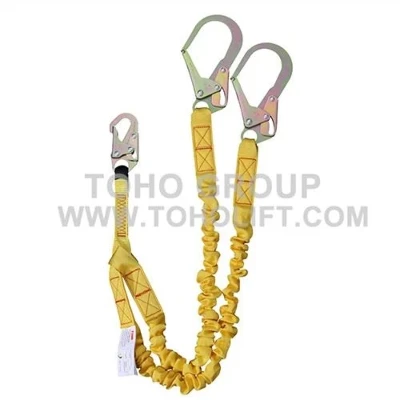
Main full body safety harness used for fall protection
How to define a full body harness?
Safety belt is mainly for fall protection, it can evenly distribute the impact force generated by a person falling to all parts of the legs and body. It is assembled by the safety belt and other accessories, the main raw material is polyester, it's low elongation rate can better prevent people from falling.
Three types of full body safety harness used for fall protection
Personal protective equipment (PPE) is used to prevent falls or to safely suspend workers after fall. According to the different using conditions, it can be divided into the following three types.
1. Safety harness for fence pole operation
The safety harness binds the human body near the fixed structure by the rope or strap, let the operator's hands can carry out other operations.
2. Area restriction safety harness
The safety harness which is used to limit the operator's activity in the area where the fall may occur.
3. Fall suspension safety harness
When the operator falls in the high altitude operation or climbing, used to hang the operator's safety harness.
Standard of full body safety harness
Systems Certification (ISO:9001:2015), under this certification, all processes and systems are stringently monitored to deliver quality product at each stage of manufacturing and service.
Product Certification (CE), nearly 100 products manufactured by TOHO are CE certified.
Safety Requirements for Full Body Harnesses (ANSI/ASSE Z359.11-2014)
Personal protective equipment against falls from a height (EN 353-1:1992)
How to put on a full body safety harness?
Check the harness by holding the D-ring buckle on the back padding of the harness to ensure that the webbing is not tangled together. Begin donning the harness by sliding the harness over your arms to your shoulders.
Ensure that all webbing is free of tangles and hangs freely. The shoulder straps must remain vertical and not close to the center of the body. Leg webbing Grab the leg straps and connect them to the buckles on the webbing on either side of the hips. Thread the excess length of webbing into the adjustment loops.
Chest webbing connects the chest straps together by threading the buckles. The chest strap must be 15cm below the shoulder and the excess length of webbing is threaded into the adjustment ring. Adjust the webbing all over the body starting at the shoulders, making sure the leg webbing is at a height just below the hips and the back D-ring is between the two shoulder blades.